

Quick Answer
The easiest way to remember stopping distance is to think of it as a three-stage process:
See → Think → Do → Stop
Your total stopping distance is the distance your vehicle travels from the moment you notice a hazard until your vehicle comes to a complete stop. It includes the distance you travel while recognizing and reacting to the hazard, plus the distance your vehicle travels after the brakes are applied.
A simple way to remember it is:
Total Stopping Distance = Reaction Distance + Braking Distance
The faster you drive, the more distance you need to stop. Wet, icy, slippery, or otherwise poor road conditions can increase braking distance even further. ICBC explains that braking distance depends on factors including speed, the vehicle and road conditions.
If you are preparing for your ICBC road test, our complete ICBC road test preparation guide can help you understand what examiners look for and how to build safer driving habits.
What Is Stopping Distance?
Stopping distance is the total distance your vehicle travels from the moment you recognize a hazard until the car comes to a complete stop.
Imagine you are driving through a residential street and suddenly see a pedestrian step toward a crosswalk.
You do not stop instantly.
First, you need to:
- See the hazard.
- Understand what is happening.
- Decide to brake.
- Move your foot to the brake pedal.
- Apply the brakes.
- Allow the vehicle to slow down and stop.
That entire process makes up your stopping distance.
ICBC describes this using the concept of See, Think and Do, followed by the braking distance required to bring the vehicle to a complete stop.
This is why simply knowing how powerful your brakes are is not enough. Your vehicle can only begin braking after you have recognized the danger and reacted.
1. What Is the Difference Between Stopping Distance and Braking Distance?
This is one of the most important concepts to understand.
Stopping distance is the complete distance required to stop.
Braking distance is only the distance your vehicle travels after the brakes have been applied until the vehicle stops.
You can think about it this way:
Stopping Distance = Reaction Distance + Braking Distance
For example, if you notice a vehicle suddenly stopping ahead of you, your car continues moving while your brain processes the situation and your foot moves to the brake.
Once the brakes are applied, the vehicle still needs additional distance to slow down.
That second part is braking distance.
Easy memory trick
Remember:
Reaction happens before braking.
So:
Stopping = Reaction + Braking
If you remember those three words, you already understand the basic relationship.
2. How Can I Easily Remember Stopping Distance?
Instead of trying to memorize a long list of numbers, use a mental sequence:
SEE → THINK → BRAKE → STOP
SEE: You notice the hazard.
THINK: Your brain identifies the danger and decides what to do.
BRAKE: You apply the brakes.
STOP: The vehicle finally comes to a complete stop.
This method is particularly useful for learner drivers because it explains why stopping distance is always greater than the distance covered after pressing the brake pedal.
ICBC notes that a driver needs time to see and think before the brakes begin slowing the vehicle.
Another easy memory formula
Total Stopping Distance = Reaction Distance + Braking Distance
Keep this formula in your head when studying.
Do not confuse it with a fixed distance that applies to every vehicle and every situation.
3. How Does Speed Affect Braking Distance?
Speed has a major effect on how far your vehicle travels before stopping.
The faster you are travelling, the more distance you generally need to stop.
There is an important principle to remember:
Increasing speed does not simply increase braking distance by the same amount.
ICBC’s driver education material explains that when speed doubles, braking distance can increase by approximately four times under comparable conditions.
This is why a small increase in speed can have a much bigger effect than many new drivers expect.
Think about it this way
At a low speed, your vehicle has relatively little momentum.
At a higher speed, the vehicle has considerably more energy and momentum that must be reduced before it can stop.
That means:
Higher speed = longer stopping distance
And:
Lower speed = shorter stopping distance
This is one reason proper speed management is such an important part of safe driving.
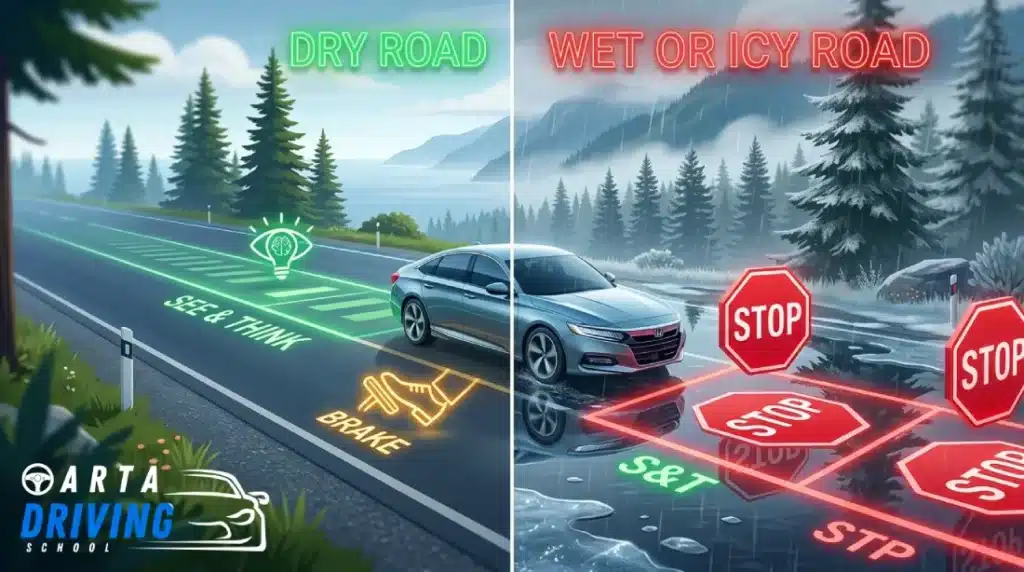
4. Does Braking Distance Increase on Wet or Icy Roads?
Yes.
Road conditions can significantly affect braking distance.
On dry pavement, your tires generally have better traction.
When the road becomes wet, snowy, icy or otherwise slippery, the available traction can decrease. This can make it harder for the tires to slow the vehicle efficiently.
ICBC specifically warns that braking distance depends on road conditions and that wet or icy conditions can increase the distance required to stop.
Remember this simple rule:
Bad conditions = more space
If the road is wet, slippery, snowy or icy, do not drive as though your vehicle will stop in the same distance as it would on dry pavement.
Instead:
- Reduce your speed when appropriate.
- Increase your following distance.
- Avoid sudden braking and steering.
- Look farther ahead.
- Give yourself more time to react.
This becomes especially important during winter driving in British Columbia.
5. How Does Reaction Time Affect Stopping Distance?
Reaction time is the time between recognizing a hazard and beginning the braking process.
This matters because your vehicle does not stop simply because you have seen the danger.
Your brain has to process what you see, decide what action is necessary and initiate the response.
During that short period, the vehicle continues travelling forward.
ICBC’s driver materials describe perception and reaction as part of the distance travelled before braking actually slows the vehicle.
What can increase reaction time?
Several things can make a driver respond more slowly, including:
- Distraction
- Fatigue
- Looking at a phone
- Poor visibility
- Alcohol or drugs
- Complex traffic situations
- Unexpected hazards
- Lack of driving experience
This is why defensive driving is not simply about knowing how to press the brake.
It is about seeing hazards early enough to have time to respond safely.
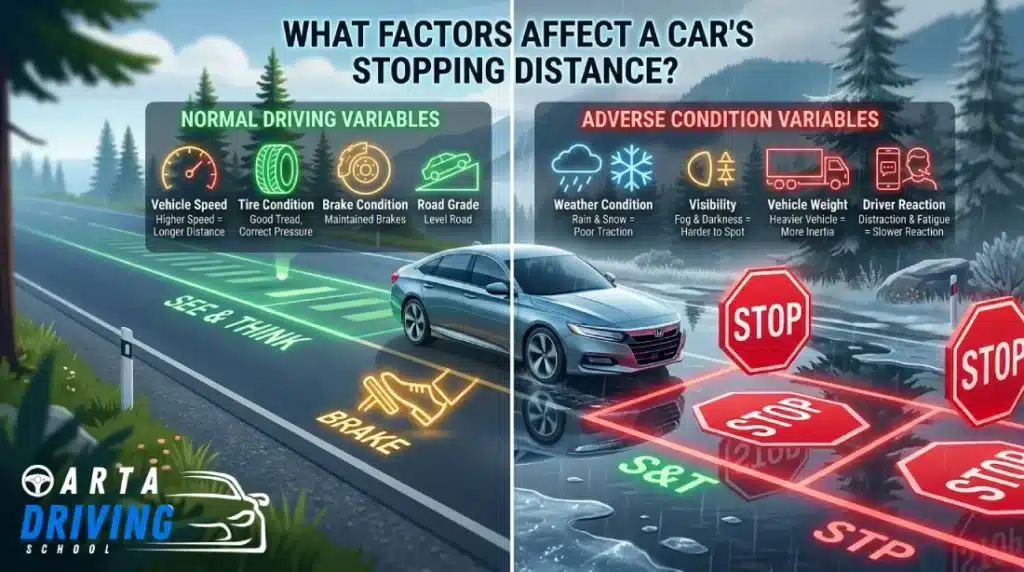
6. What Factors Affect a Car’s Stopping Distance?
Stopping distance is not determined by speed alone.
Several factors can influence how far your vehicle needs to stop.
1. Vehicle Speed
Higher speed generally means greater stopping distance.
2. Road Surface
Wet, icy, snowy, gravel or slippery surfaces can reduce traction.
3. Tire Condition
Tires need sufficient tread and proper inflation to provide effective contact with the road.
4. Brake Condition
Brake components that are worn or not functioning properly can affect braking performance.
5. Vehicle Weight
A heavier vehicle may require different braking performance than a lighter vehicle.
6. Road Grade
A vehicle travelling downhill can require more stopping distance because gravity is working with the vehicle’s forward movement. ICBC commercial-driver material specifically identifies road slope as a factor in stopping distance.
7. Driver Reaction
A distracted or tired driver may take longer to respond to a hazard.
8. Visibility
Fog, darkness, heavy rain and other visibility problems can make hazards harder to identify early.
So there is no single stopping-distance number that is correct for every car, driver and road.
7. How Can I Estimate How Far My Car Needs to Stop?
For everyday driving in British Columbia, the best approach is not to rely on one memorized stopping-distance chart.
Instead, think about the conditions around you.
Ask yourself:
How fast am I travelling?
How good is the road surface?
How much traction do I have?
How alert am I?
How far ahead can I see?
Is there enough space in front of me if something unexpected happens?
This way of thinking is more useful than memorizing one number because real-world driving conditions constantly change.
For example, the stopping distance you need on a dry road at a moderate speed may be very different from what you need on an icy downhill road.
The safest driver constantly adjusts speed and following distance according to the situation.
8. Why Is Following Distance Important for Stopping Safely?
Following distance gives you the time and space you need to react if the vehicle ahead suddenly slows or stops.
If you follow another vehicle too closely, even a perfectly functioning braking system may not save you from a collision because you may not have enough time or space to react.
ICBC emphasizes maintaining enough space around your vehicle and allowing sufficient following distance because stopping requires both reaction time and braking distance.
A useful habit
Do not simply ask:
“Can I stop if the car ahead brakes?”
Ask:
“Do I have enough space if the car ahead brakes suddenly?”
That small change in thinking can make a major difference.
In normal conditions, maintain an appropriate following distance and increase it when conditions become worse.
More space gives you more options.Developing strong defensive driving skills can help you recognize hazards earlier and maintain the space you need to react safely.
9. What Is the Best Way to Remember Stopping Distance for an ICBC Road Test?
If you are preparing for an ICBC Class 5 or Class 7 road test, do not focus only on memorizing numbers.
Focus on demonstrating safe driving behaviour.
During your road test preparation, remember these principles:
Look ahead
Scan the road far enough ahead to identify hazards before they become emergencies.
Control your speed
Choose a safe speed for the posted limit, traffic, visibility and road conditions.
Leave enough space
Maintain an appropriate following distance so you have time to react.
Brake smoothly
Avoid unnecessary harsh braking. Good drivers anticipate hazards and adjust their speed early.
Complete your stops
When a complete stop is required, bring the vehicle to a full stop at the correct location.
Continue observing
Stopping is not the end of the observation process. Check intersections, pedestrians, cyclists and surrounding traffic before continuing.
These habits fit naturally into broader ICBC road-test preparation, where vehicle control, observation, speed management, road positioning and safe decision-making are important skills.
For more road-test preparation advice, see our ICBC road test guide.
Understanding stopping distance can also help you avoid some of the ICBC road test mistakes that come from poor speed control, unsafe following distance and late reactions.
10. What Is the Easiest Memory Trick for Stopping and Braking Distance?
Here is the simplest version to remember:
SEE → THINK → BRAKE → STOP
Then remember:
Stopping Distance = Reaction Distance + Braking Distance
And finally:
More Speed + Worse Conditions = More Stopping Distance
That’s it.
You do not need to turn stopping distance into a complicated mathematics problem every time you get behind the wheel.
A good driver develops the habit of continuously asking:
“If something happens right now, do I have enough space to stop safely?”
That question is far more useful on the road than memorizing a single number.
A Simple Stopping-Distance Memory Card
If you are studying for your knowledge test or preparing for your road test, save this:
STOPPING DISTANCE
1. SEE
Notice the hazard.
2. THINK
Recognize the danger and decide what to do.
3. REACT
Move your foot toward the brake.
4. BRAKE
Apply the brakes.
5. STOP
Allow the vehicle enough distance to come to a complete stop.
Remember:
Total Stopping Distance = Reaction Distance + Braking Distance
Higher speed = longer stopping distance
Poor road conditions = longer braking distance
More following space = more time to react
Final Takeaway
Learning stopping distance is not really about memorizing a giant table of numbers.
It is about understanding what happens between the moment you see a hazard and the moment your vehicle stops.
Remember:
SEE → THINK → BRAKE → STOP
When you combine good observation, appropriate speed, safe following distance and smooth braking, you give yourself something every driver needs:
time and space to make a safe decision.
And that is especially important when preparing for an ICBC road test.If you’re preparing for your test in Metro Vancouver, you can also explore our guide to ICBC road test locations in Vancouver, Burnaby, Coquitlam and North Vancouver.
🚗 Want to Become More Confident Behind the Wheel?
Understanding stopping distance is only one part of becoming a safe and confident driver.
At ARTA Driving School, lessons are designed to help learners build practical driving skills through one-on-one in-car instruction, including vehicle control, observation, defensive driving, parking, lane changes and road-test preparation.
If you are preparing for your ICBC road test and want an instructor to help you identify the habits that could affect your performance, book a driving lesson with ARTA Driving School and practise these skills in real traffic with professional guidance.
Your goal isn’t simply to memorize the rules. It’s to make safe driving decisions automatically when it matters most.