
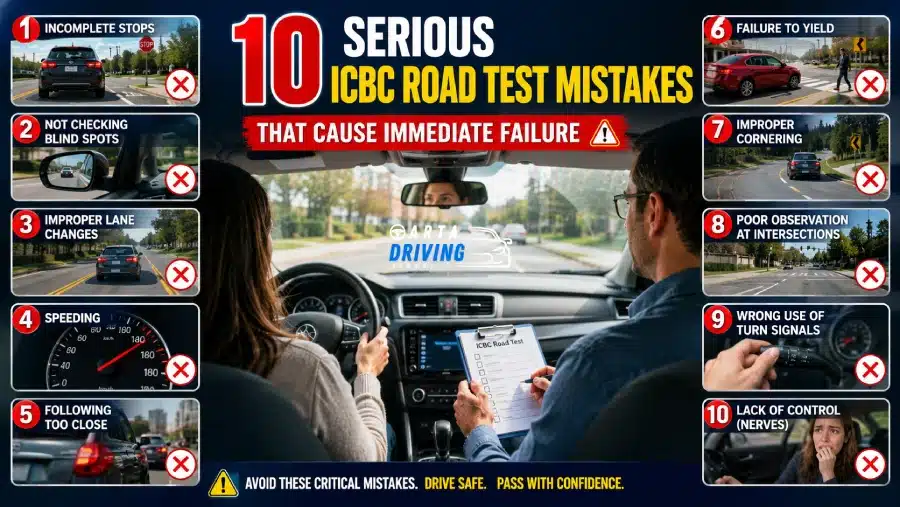
When you are getting ready for your Class 7 or Class 5 ICBC road test it can be really scary. A lot of people who are learning to drive worry that if they make one mistake like touching a curb while parking or going a bit too fast they will automatically fail the test.
The truth is, the people who give the ICBC road tests are not looking for tiny mistakes to fail you on. They want to see if you can drive safely and follow the rules of the road. They are checking to see if you are a driver not if you are perfect.
So what can make you fail the ICBC road test away? If you do something that’s really dangerous like run a red light or almost hit someone the test will be stopped right then. This is because the tester needs to make sure you are safe to drive.
Quick Answer:
An automatic fail on an ICBC road test occurs when a driver commits a critical safety violation, creates an immediate hazard, or breaks a traffic law that requires the driver examiner to verbally or physically intervene. While ICBC evaluators assess overall driving competency, actions such as failing to yield right-of-way, running a red light or stop sign, causing a hazard during a lane change, speeding in playground/school zones, or entering an intersection unsafely result in an immediate failure.
Unlike minor skill deductions (such as steering refinement or slight positioning errors), these critical hazards directly compromise road safety.
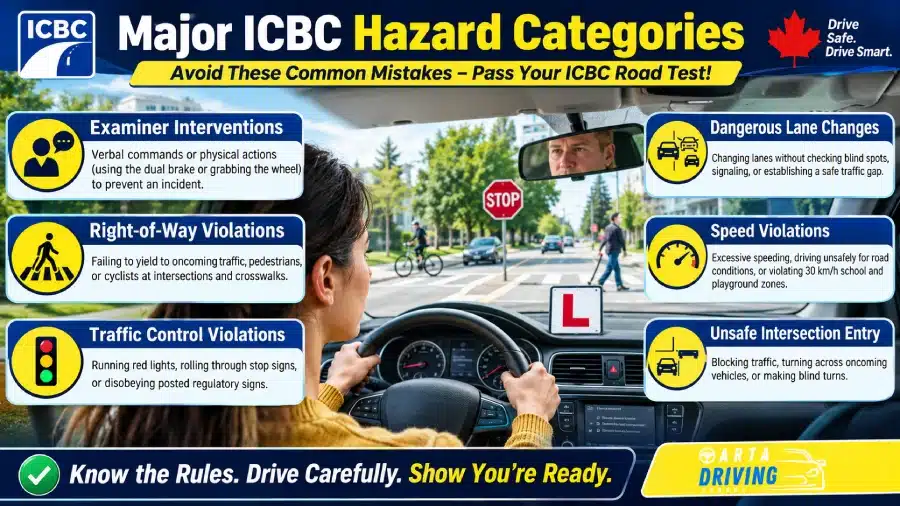
Major ICBC Hazard Categories:
-
Examiner Interventions: Verbal commands or physical actions (using the dual brake or grabbing the wheel) to prevent an incident.
-
Right-of-Way Violations: Failing to yield to oncoming traffic, pedestrians, or cyclists at intersections and crosswalks.
-
Traffic Control Violations: Running red lights, rolling through stop signs, or disobeying posted regulatory signs.
-
Dangerous Lane Changes: Changing lanes without checking blind spots, signaling, or establishing a safe traffic gap.
-
Speed Violations: Excessive speeding, driving unsafely for road conditions, or violating 30 km/h school and playground zones.
-
Unsafe Intersection Entry: Blocking traffic, turning across oncoming vehicles, or making blind turns.
What Does “Automatic Fail” Actually Mean on an ICBC Road Test?
The phrase “automatic fail” is commonly used by learner drivers, but ICBC evaluation sheets classify test-ending errors using specific professional terminology: Dangerous Actions, Critical Errors, and Examiner Interventions.
ICBC Examiners recognize two types of driving faults;
Minor Assessment Deductions- Technical small mistakes such as needing two actions to perform a reverse stall, slightly mis-aligning position at the curb, or pausing momentarily in a clear intersection. These are marked off as a point deduction, but are only a reason to pass or fail if you have too many in one specific area. A single minor mistake alone is not going to cause you to fail.
Dangerous Actions and Interventions- Driving into an situation or performing an action that will cause a safety concern, force another driver or pedestrian to react and evade, break the B.C. Motor Vehicle Act, or if the examiner grabs steering wheel, or presses the dual brake. This is an automatic failure.
Context is a key to most evaluations. For example, bumping up against a softer curb at 2 km an hour when parallel parking and staying on the road will not be assessed as dangerous as hitting a curb hard at 20 km an hour, or mounting a sidewalk in a location with pedestrian traffic. Examiners are looking at the hazard created by the driver’s actions or choices.
Top 10 Automatic Fail Hazards to Avoid on the ICBC Road Test
1. Creating a Dangerous Situation That Requires Examiner Intervention
What happens: The examiner must physically take control (e.g., dual pedal or steering wheel) or make an immediate verbal command or warning to prevent an imminent collision.
Why it is serious: The fact that the examiner had to intervene signifies that the driver was unable to identify and appropriately react to an immediate roadway hazard and therefore is unsafe to operate the vehicle.
The road test scenario: You are attempting to make a right turn on a green light in North Vancouver, but do not observe a pedestrian entering the marked crosswalk. The examiner presses the dual brake pedal and stops the vehicle.
What the safe driver would have done: Maintained constant observation and scans. The examiner would scan crosswalks and the curb area ahead before proceeding with the right turn. The driver would also scan blind spots and approach sidewalk areas before committing.
How to eliminate this hazard: Establish a scanning habit; do not proceed with a movement until you have confirmed that it is clear with your eyes. Ensure you check for pedestrians, cyclists, and approaching traffic every time.
Important note: Any physical intervention immediately results in failure. Safety interventions are emergency instructions or an examiner controlling the pedals/steering; they are distinct from clarifying instructional wording.
2. Failing to Stop or Yield When Required by Law
What happens The driver rolls through a stop sign, blows past a yield sign, or cuts off traffic and pedestrians. Why it is serious Running past signs is a direct way that T-bone, pedestrian and all sorts of catastrophic intersection crashes are created. Road test example Imagine driving through a 30kmh residential zone and approaching a red, octagonal stop sign.
You check in one direction, you check the other direction, then you give 5kmh worth of acceleration without a complete, total stop first over the stop line or cross walk.
What a safer road test candidate would do You slow your vehicle down to at least a complete, total, one hundred per cent stopped motion, right up against your designated stop line, the edge of a paved crosswalk or where the sidewalk would touch the road. Once fully and completely stopped and the force that pulls you back over the rear axle, the brake feel has relaxed off its all clear and proceed. How to Avoid This particular Safety Risk Every single stop sign must be considered a mandatory full stop at some point. Be certain to feel the weight shift to the back before deciding you see all of clear and clear.
What to Know “Rolling stops” are considered a serious driving offence (failing to follow a traffic device) that will result in you failing on any ICBC test.
3. Causing or Being Involved in a Preventable Collision
What Occurs: The motor vehicle is in direct physical contact with another automobile, structure, bicycle, or person, as a result of driving error or a lack of hazard perception.
Why it is serious: This indicates a complete loss of vehicle control and/or situational awareness or spatial judgement.
Road Test Scenario: At the end of your test as you are parallel parking in a space at the ICBC drivers licensing office, your reverse motion takes you into the other vehicle. The examiner notes that you lightly touched the bumper of an adjacent vehicle in the process of stopping while reversing.
Safer Driving: The use of mirrors, backup camera as a backup guide, and a 360 check and backing at a slow walk should have preceded the contact. Stop at the slightest doubt about distance.
How to avoid hazard: Practice spatial positioning relative to structures and other vehicles. If at any point in a maneuver you become unsure about your position, stop and rethink.
Additional info: This can be similar to the vehicle behind, which has caused the crash, for a red light situation where the vehicle stopped properly without regard to this specific hazard. This would generally not be counted against driver skill unless a better method of avoiding it should have been performed (like double checking mirrors in stop and go traffic to sense how far behind the other vehicle was when you had to stop quickly).
4. Making a Dangerous Lane Change
What’s happening: Moving sideways into a lane without proper mirror checks, shoulder checks, signal or selecting safe space within the traffic flow.
Why it’s dangerous: Unsafe lane changes cut off other traffic, causing cars behind to brake, and forcing you into side-swipe collisions with cars in a blind spot.
Road Test example: You signal to move into the right lane of a multi-lane corridor in Burnaby, only checking your rear-view mirror before actually taking the wheel,cutting a cyclist moving in the bike lane.
What a safe driver does: Follow the mirror-signal-shoulder check procedure. Scan with your eyes through a full 45-90 degree angle in the appropriate blind spot and actually move the wheel after visual confirmation is made.
How to avoid it: Physically turn your head during every single lane change, merger and turn. NEVER look only in your side or rear view mirrors.
Context: If a shoulder check is not made when a Hazard is clearly not present, this is still a deduction. If a shoulder check is not made and an oncoming car or cyclist is cut off, this becomes an immediate Dangerous maneuver.
5. Failing to Check for Pedestrians, Cyclists, or Vulnerable Road Users
This Is What Is Happening: Driving in areas (crosswalks, bike lanes, intersections, school zones) that must be checked for all vulnerable road users, without actually doing the checking.
This is Why It’s So Dangerous: Pedestrians and cyclists offer their own body to absorb impacts, meaning they can be very severely injured or killed by even slow-moving vehicles without any physical protection or vehicle crash absorbing structure.
This is How it Can Show Up: On the right-turn test, you check on-coming traffic, glance right, but do not shoulder-check on the right-rear blind spot for a cyclist coming straight along the lane.
This is What the safer driver does: V.R.U. Scans first. Always scan right for vehicles/cyclists on a right-turn with a bike lane or painted shoulder. Perform a right shoulder check.
This is How Not to Get Caught: Make a scan scan on the side walks, transit stops, and crosswalk entrance (50 meters forward) of the vehicle.
This applies in this dangerous context: it is considered entering the pedestrian corridor and failure to yield to a pedestrian stepping onto any part of a signaled, unmarked or marked crosswalk on the driver’s portion of the roadway is also an obvious breach of B.C. Law.
6. Serious Speed-Related Errors
What it is: Significantly speeding, illegally exceeding a 30 km/h school and playground speed zone, or speeding at unsafe levels for current road and weather conditions.
How dangerous it is: It decreases stopping distance, reduces reaction time and increases collision forces.
Road Test Scenario: You drive past a 30 km/h sign for a playground within a residential area at 8:30 am in second gear. At 45 kph, you are still 25 metres from the sign; you proceed to pass the sign without slowing.
What safe driver would do: Continually scan for regulatory speed limit signs and immediately begin to slow for a 30 kph school/playground speed zone before reaching the entry sign. Maintain speed, then increase to the posted speed limit and gradually return to the posted speed limit after you pass the exit sign for the school/playground speed zone.
How to avoid hazard: Continue to focus on your speedometer as part of instrument scan. Always check for school zone hours, school/playground signs and road weather hazards.
Additional information: A slightly fast reading or slightly slow reading on the speedometer (e.g. Your speedometer reading1 to 2 kphfast for a few seconds on a downhill, which you quickly bring back to an acceptable reading with light braking) would likely be marked as a small point deduction. An ongoing speed problem or ongoing school zone speed violation is considered a critically hazardous action.
7. Entering an Intersection or Turning Unsafely
What Happens: Making a turn at an intersection with out checking for, or finding, acceptable gaps in oncoming traffic. Effectively stalls oncoming cross-traffic; turns blindly.
Consequences: Unsafe intersection entries contribute to 90% of all serious broadside crashes in B.C.
Sample Road Test Scenario: As you wait to make a left turn on a green light, an unprotected green, you underestimate the speed of the car coming toward you and turn, causing the approaching car to slam on its brakes in order to miss running into you.
What a Safer Driver Should Do: Wait for a large enough break in oncoming traffic. If performing an S turn, get ready to turn into the intersection, keep the wheels straight until beginning the turn.
How to prevent This hazard: The rule of thumb is to wait if you are not sure. If a vehicle is pressing on the back, do not be pressured to turn into a tight slot.
Significant Context: Not hesitating despite on-comingtraffic blocking the view of the turning car may indicate sound judgement of the hazard rather than a paradoxicalunder-hesitation.
8. Ignoring Traffic Signals or Traffic Control Requirements
What Happens Enter an intersection with a red light; Speeding through a solid yellow light when it was possible to stop, and ignore traffic light arrows or signs. Why It Is A Dangerous Offense Traffic lights manage the most congested intersections, the result of not respecting signals are fatal speed side-impact and head-on accidents. Example of a driving test situation A green light inCoquitlam turns solid yellow as you approach an intersection, and you have lots of room to stop carefully, so you hit the accelerator to drive “under the light,” not only clearing the stop line AFTER the signal is red, but actually entering the intersection.
What A Responsible Driver Would Do: If it’s possible to do so safely, without risking being hit from behind by another vehicle, a solid yellow light means you must prepare to stop.
How To Prevent This Hazard: Recognize stale greens (lights which have been green for a little too long) by monitoring signal countdowns and have your foot poised over the brake and READY to go at the ‘ decision point.’ Additional Notes:Ifyou were already legally within the intersection already to make a left turn on a green signal then you are allowed, and in fact, are required, to complete your turn before stopping even if the light is no longer green.
9. Losing Proper Vehicle Control During a Critical Manoeuvre
What happens: Demonstrates a lack of physical control over the vehicle when stalled, for instance where there is very heavy stalling (with a manual gear box vehicle), with erratic steering, mount a sidewalk curb, or move the vehicle backwards during a hill-start. Why it is critical: Loss of physical control at slow speeds has the potential of posing a hazard to other moving vehicles, parked vehicles, or persons walking on a sidewalk. A road test illustration In a hill start situation you let the vehicle move backwardswards about more than 1 meter, in the direction of an occupied parked car behind you, or mounting completely the sidewalk edge when attempting a parallel parking maneuver.
What a safer driver would do Operate the accelerator, clutch and brake pedals, using steering to adjust the vehicle, utilize parking break on steep hill-starts and keep the movement of the vehicle under command.
How to get around the risk Practice steering in a confined spaced till the controls are a smooth and intuitive. Additional Information Minor scuff or hit of the curb while in parking at a walking pace isn’t regarded as a critical error but should be scored as a slight positional error. Mounting the pavement wholly with one of vehicle’s wheels in parking would cause the hazard and is critically fault.
10. Making a Decision That Creates an Immediate Safety Risk
What: Making stupid/unpredictable decisions while driving that put you or others at an immediate risk, for example: abruptly stopping on the highway or overtaking school buses with red lights on.
Why it is a big deal: Driver safety is contingent on predictable traffic. Making unpredictable decisions, especially that are dangerous will cause secondary collisions and increase the likelihood of unpredictable traffic.
How it could appear on the road test: You are approaching a 2-way stop and stop to let a vehicle coming off the 2-way street which should yield to you cut in front of you. Traffic starts backing up from the vehicle that has cut into traffic and there is a danger of the car behind you colliding with you.
What should safe driver do instead: Know what the rules regarding yielding are. Let traffic flow continuously and follow other priority rules.
How to minimize this hazard: Memorise the ICBC Learn to drive Smart rule regarding yielding at 2 way stops, 4-way stops, traffic circles and uncontrolled intersections.
Key point: all traffic laws are about predictability; be polite in driving when possible but not at the expense of safe predictable traffic.
Automatic Fail vs. Minor Mistake: What Is the Difference?
To reduce test-day anxiety, review how ICBC driver examiners differentiate between minor execution errors and major safety hazards:
| Driving Situation | Potential Severity | Why It Matters | What the Driver Should Focus On |
| Touching a curb while parallel parking | Minor Mistake | Indicates slight spatial misjudgment, but poses minimal immediate danger at walking speeds. | Reversing slowly, adjusting mirrors, and correcting position safely. |
| Mounting a sidewalk curb completely | Critical Hazard / Automatic Fail | Poses an immediate threat to pedestrians on the sidewalk. | Stopping immediately, checking surroundings, and maintaining steering control. |
| Momentary 2 km/h speed fluctuation | Minor Mistake | Slight variance occurring during road slope changes quickly corrected by driver. | Checking speedometer periodically and maintaining smooth throttle control. |
| Speeding in a 30 km/h School Zone | Critical Hazard / Automatic Fail | Violates BC Motor Vehicle Act; endangers children in high-risk zones. | Scanning for zone entry signs and decelerating before entering the boundary. |
| Hesitating briefly at a clear intersection | Minor Mistake | Indicates extra caution, though excessive delay can disrupt traffic flow over time. | Building confidence through gap judgment practice. |
| Turning across oncoming traffic unsafe gap | Critical Hazard / Automatic Fail | Risks severe broadside collision; forces oncoming vehicle to take evasive action. | Waiting for a clear gap; keeping wheels straight until committing to turn. |
| Forgetting a signal during parking | Minor Mistake | Technical omission that reduces communication when no nearby traffic is affected. | Using the Mirror-Signal-Maneuver routine consistently. |
| Changing lanes without a shoulder check | Critical Hazard / Automatic Fail | Creates an immediate side-swipe risk with blind-spot traffic or cyclists. | Physically turning head 45–90 degrees to check blind spot every time. |
Common Misunderstandings About Automatic Fails
Myth 1: “One small mistake equals failure.”
Fact: Road tests on ICBC facilities gauge overall driving competence, with testers looking for development of safe, driving habits-not absolute perfections. In fact, examiners will give room for minor technical mistakes (e.g., an awkward shoulder steering correction or double-booking parking in reverse) if the error poses no safety concerns.
Myth 2: “Any curb contact immediately results in a fail.”
Fact: The consequences of striking a curb depend on severity. If one of your tires gently nips or lightly grazes the curb at 2 kilometers per hour during parallel parking and doesn’t jump over it, a small spatial deduction will be issued. But if you severely smash or mount the curb during, for instance, a wide U-turn at a high rate of speed, the action will be a high risk, safety hazard–a critical control error, in other words.
Myth 3: “Failure to perform one shoulder check fails the test.”
Fact: Forgetting to complete a shoulder check during a simple cornering manoeuvre when other users, bicycles, pedestrians etc are absent from that intersection will results in a demerit against “Observation skills” on your feedback sheet. Not seeing, as well as not performing a shoulder check prior to changing lanes or cutting a corner to make a turn that takes up the path of a cyclist or vehicle is considered an immediate dangerous driving behaviour.
Myth 4: “Driving under the speed limit causes an automatic failure.”
Fact: Driving in accordance with the prevailing speed of vehicles on the roadway in relation to weather and visibility conditions (i.e. Travelling 40 kph in a posted speed zone of 50 kph in the rain) constitutes a well controlled manoeuvre of vehicle. Driving excessively slow on a clear highway lane (e.g. Doing 50 kph in a posted zone of 90 kph for no apparent reasons) is deemed creating a hazard of traffic obstruction and warrants deductions on your report card, but is not an immediate fail.
Myth 5: “There’s no point in trying after I’ve made just one error. I’ve already failed.”
Fact: We are sometimes informed of candidates misunderstanding comments on the back page of their feedback sheet to signal failure. For the majority of students having made a minor mistake on the driving test, all the test candidates that managed to keep composure throughout the rest of their test that continued driving and passed the road test at theICBC. Never assume that you’ve failed-always complete the drive test, until you are back in the parking spotat your ICBC centre.
How to Reduce Your Risk of Serious Errors Before the ICBC Road Test
Developing habits that prevent critical errors requires structured, deliberate practice. Focus on these five core driver competencies during your pre-test preparation:
-
Systematic Observation Routine (MSM):
-
Practice the Mirror – Signal – Shoulder Check routine until it becomes automatic.
-
Perform shoulder checks before every turn, lane change, exit from a curb, or movement across bike lanes.
-
Scan intersections left, center, right, and left again before entering.
-
-
Proactive Speed Control & Zone Awareness:
-
Watch for yellow top-border signs indicating upcoming school and playground zones.
-
Adjust your speed using smooth braking before crossing speed-limit thresholds.
-
Check your speedometer every 8 to 12 seconds during straight-line driving.
-
-
Hazard Perception & Vulnerable User Scanning:
-
Actively scan sidewalks, driveway exits, bus stops, and bike corridors for movement.
-
Cover your brake pedal (move your foot over the brake without pressing it) when approaching unpredictable situations, such as pedestrians standing near crosswalk edges.
-
-
Patient Gap Selection:
-
Choose conservative, safe gaps when making left turns across oncoming traffic.
-
Never rush an intersection turn to satisfy drivers behind you.
-
-
Mock Road Test Practice Under Realistic Conditions:
-
Take practice runs in complex driving environments near ICBC test centers (e.g., navigating Vancouver bike routes, Coquitlam hills, or North Vancouver highway merges).
-
Practice under professional evaluation conditions to identify unknown habits or blind spots.
-
Frequently Asked Questions (FAQ)
What can fail you automatically on an ICBC road test?
An automatic fail occurs when a driver commits a dangerous action, violates a Motor Vehicle Act law, creates an immediate hazard, or causes the examiner to physically or verbally intervene to maintain safety.
Does examiner intervention mean you automatically failed?
Yes. If an examiner uses the dual brake pedal, touches the steering wheel, or issues an urgent physical or verbal direction to prevent a collision or safety violation, the road test results in an immediate failure.
Is hitting the curb an automatic fail on an ICBC road test?
Not necessarily. Lightly touching or grazing a curb at low speed while parallel parking is marked as a minor spatial error. However, striking the curb hard at speed, mounting the sidewalk, or striking fixed structures causes an automatic failure.
Can you fail for missing a single shoulder check?
Omitting one shoulder check when no hazard is present results in a minor point deduction under observation skills. However, omitting a shoulder check that leads to cutting off another vehicle, cyclist, or pedestrian constitutes a critical safety error and causes a failure.
Is speeding an automatic fail on the ICBC road test?
Persistent speeding, driving significantly over the legal speed limit, or violating 30 km/h school and playground zone restrictions leads to a critical error or automatic fail. Brief, minor speed variations that are quickly corrected are evaluated as minor deductions.
Can you fail for driving too slowly during the test?
Yes. Driving unnecessarily slow (e.g., 30 km/h in a clear 50 km/h main arterial zone with no traffic or weather hazards) obstructs traffic flow, creates frustration for surrounding drivers, and can lead to a test failure under traffic flow violations.
Is running a stop sign an automatic fail?
Yes. Failing to come to a complete stop at a stop sign (“rolling stop”) is a violation of BC Motor Vehicle Act laws and is evaluated as a critical safety error.
How many minor mistakes are allowed on the ICBC road test?
ICBC does not publish a single “magic number” of allowable deductions. Assessment forms categorize skills (such as observation, space management, and vehicle control). Accumulating multiple deductions within the same skill category demonstrates a pattern of incompetency and will result in a failure, even without a single dangerous action.
Mastering Your ICBC Road Test with Confidence
Your ICBC Class 5 or Class 7 road test is not a perfectly choreographed ballet-rather an assessment by which ICBC will evaluate if you are a safe, predictable and observant driver who obeys the laws of BC. Knowing what is a real safety/dangerous maneuver and what is a minor tech error will relieve much pressure on the actual test.
Discovering and rectifying your own blind spots before your ICBC road test date is the most beneficial aspect in eliminating critical errors and is essential. By practicing with fully certified instructors, you can iron out your scanning routine, learn how to navigate challenging intersections and have realistic reviews under official ICBC standards.