

If you want to drive a taxi, limousine, Uber or Lyft vehicle, small shuttle bus, or hotel/airport van in British Columbia, you need a Class 4 driver’s license. This isn’t an upgrade you can get by simply paying a fee — ICBC requires a medical exam, a driving record review, and in most cases a Class 4 road test conducted by a licensed driving examiner.
This guide was built by reviewing current ICBC licensing rules, analyzing what new commercial drivers in Burnaby, Vancouver, North Vancouver, and Coquitlam actually struggle with, and combining that with real road test coaching experience from ARTA Driving School. It answers every question a first-time applicant, a career-changer, or a rideshare driver might have — in one place, without fluff.
“Quick Answer: A Class 4 driving school teaches you the specific skills, passenger-safety procedures, and vehicle-handling techniques needed to pass the ICBC Class 4 road test, which is required to legally drive taxis, limousines, small buses (up to 20 passengers), and ambulances in BC.”
What Is a Class 4 License in BC?
Definition: A Class 4 license is a commercial driving credential issued by ICBC that authorizes a driver to operate vehicles used to transport paying passengers or members of the public, including taxis, limousines, ambulances, and small buses.
In BC, driver licensing is tiered from Class 1 (tractor-trailers) down to Class 7 (learner). Class 4 sits between Class 5 (standard passenger vehicle) and Class 3 (larger trucks), and it exists specifically because carrying paying or vulnerable passengers requires a higher standard of care than private driving.
ICBC treats Class 4 as a “for-hire” or “public safety” license category. That means the licensing process includes checks that don’t exist for a regular Class 5 license — a medical fitness review and, for most first-time applicants, a hands-on road test in a representative vehicle.
Why it matters: Passengers getting into a taxi, Access bus, or limousine have no control over who is driving. ICBC’s extra screening exists to protect that public trust.
Class 4 Restricted vs. Class 4 Unrestricted
ICBC issues two versions of the Class 4 license, and confusing the two is one of the most common mistakes new applicants make.
| License Type | What It Allows | Typical Drivers |
|---|---|---|
| Class 4 Restricted | Driving a vehicle designed to seat no more than 10 people (including the driver) when used to carry paying passengers | Uber/Lyft drivers, small for-hire vehicles |
| Class 4 Unrestricted | Everything in Restricted, PLUS driving taxis, limousines, ambulances, and buses/vans with a seating capacity up to 20 (including the driver) | Taxi drivers, limo drivers, small/medium bus drivers, ambulance drivers |
Key takeaway: If you only plan to drive for a ride-hailing app, the Restricted class is usually sufficient. If you want to drive a taxi, limousine, or any bus-style vehicle, you need the Unrestricted class. Always confirm the exact requirement for your specific job with your employer or ICBC, since vehicle configuration (seating, wheelchair accessibility, etc.) can affect which class applies.
Who Actually Needs a Class 4 License?
You are legally required to hold a Class 4 license if you plan to drive any of the following in British Columbia:
- Taxis and ride-hailing vehicles (Uber, Lyft, Kater, etc.)
- Limousines
- Airport shuttles and hotel courtesy vans
- Small to medium buses (up to 20 passengers, including the driver)
- Ambulances (non-emergency and some emergency transport roles)
- Care facility or medical transport vehicles carrying clients
- Some tour and sightseeing vehicles
Not required for: personal vehicle use, carpooling without payment, or driving a standard passenger car for non-commercial purposes — those only require a Class 5 or Class 7 license.
Class 4 vs Class 5 vs Class 3: Full Comparison
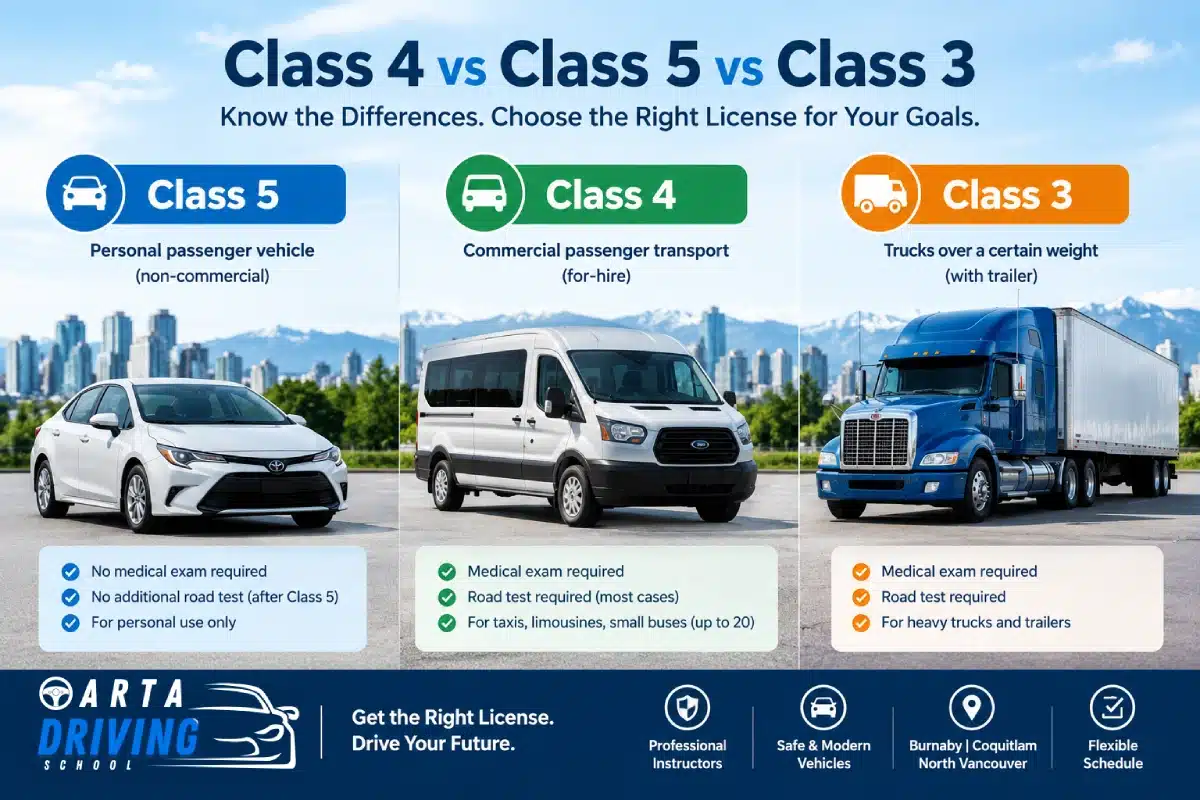
| Feature | Class 5 | Class 4 | Class 3 |
|---|---|---|---|
| Purpose | Personal passenger vehicle | Commercial passenger transport (for-hire) | Trucks over a certain weight, with trailer |
| Medical exam required | No | Yes | Yes |
| Road test vehicle | Personal car | Representative vehicle (car, van, or bus depending on use) | Truck meeting weight class |
| Knowledge test | At Class 7 stage only | Usually required for first-time applicants | Required |
| Who uses it | General public | Taxi, limo, shuttle, ambulance drivers | Dump truck, tow truck, delivery truck drivers |
| Age minimum | 16 (Class 7) | 19, or 18 with 2 years of licensed experience | 18–19 depending on conditions |
| Renewal frequency | Standard | More frequent medical review as driver ages | More frequent medical review as driver ages |
Eligibility Requirements
Before booking a road test, ICBC requires applicants to meet these baseline conditions. Always verify the current requirements directly on icbc.com before applying, as policies can be updated.
- Age: Generally 19 years or older. Applicants who are 18 may qualify if they have held a full-privilege Class 5 or Class 7 (non-learner) license for at least two years.
- Valid license: You must already hold a valid BC Class 5 or Class 7 license with full driving privileges (not in the “L” learner stage).
- Driving record: ICBC reviews your driving history. A pattern of serious violations, excessive points, or recent prohibitions can delay or disqualify your application.
- Medical fitness: A completed Driver’s Medical Examination Report from a physician or nurse practitioner.
- Vision standard: You must meet ICBC’s minimum vision requirements, with correction if needed.
- Knowledge test: Typically required for first-time Class 4 applicants (confirm with ICBC whether this applies to your situation).
- Road test: A practical driving exam in a vehicle representative of the class you’re applying for.
“Expert Insight: Many applicants assume a clean record from years ago is enough. ICBC’s driving record review looks at recent history, so a ticket or at-fault incident within the last few years can still be flagged. If you’re unsure about your record, order your driver’s abstract from ICBC before applying.”
Step-by-Step: How to Get a Class 4 License in BC
- Confirm you meet the age and licensing prerequisites (Class 5/7 full privilege, correct age).
- Book and complete your Driver’s Medical Examination Report with your doctor or nurse practitioner.
- Submit your application and medical report at an ICBC driver licensing office.
- Complete the knowledge test (if required for your situation).
- Practice with a Class 4 driving school in a vehicle representative of your target job (sedan, van, or small bus).
- Book your Class 4 road test through ICBC.
- Pass the road test and receive your Class 4 license.
- Maintain your license by renewing your medical report on ICBC’s required schedule and keeping a clean driving record.
The Class 4 Medical Exam
Definition: The Driver’s Medical Examination Report is a standardized ICBC form completed by a licensed physician or nurse practitioner that assesses your physical and mental fitness to safely operate a commercial passenger vehicle.
The exam typically reviews:
- Vision and hearing
- Cardiovascular health
- Neurological function
- Musculoskeletal mobility
- Any medications that could impair driving ability
Why this step exists: Commercial drivers spend significantly more hours behind the wheel and are responsible for passengers who cannot assess the driver’s fitness themselves. ICBC uses the medical report to screen for conditions that could create a public safety risk.
Renewal frequency: ICBC requires periodic medical re-certification for commercial license holders, with more frequent checks as drivers get older. Because exact intervals can change, confirm your renewal schedule directly with ICBC or your medical practitioner at the time of application.
The Class 4 Knowledge Test
The knowledge test (where applicable) evaluates your understanding of:
- BC’s commercial passenger transport regulations
- Passenger safety procedures (boarding, securing wheelchairs, emergency evacuation)
- Vehicle-specific rules for taxis, limousines, or buses
- Defensive driving concepts specific to carrying passengers
Tip: Study the current ICBC Commercial Driver’s Guide thoroughly rather than relying on generic road-rule apps, since the Class 4 test includes passenger-safety content not covered in the standard Class 5/7 knowledge test.
The Class 4 Road Test: What to Expect
This is the section most applicants search for — and where most competitor content falls short by only listing generic “road test tips.” Here’s what the Class 4 road test actually evaluates.
What the Examiner Assesses
| Skill Area | What’s Being Tested |
|---|---|
| Vehicle control | Smooth acceleration, braking, steering, and gear/mirror use in a larger or passenger-configured vehicle |
| Passenger safety awareness | Checking mirrors before moving, safe stopping distance from curbs, smooth starts/stops to avoid jostling passengers |
| Space and hazard management | Scanning for pedestrians near loading zones, cyclists, and other vehicles in commercial/urban routes |
| Specific maneuvers | Three-point turns, parallel parking, reversing, lane changes, and intersection handling in the representative vehicle |
| Rules compliance | Obeying speed limits, right-of-way, and commercial vehicle-specific regulations |
| Communication and professionalism | Signal use, following examiner instructions, and overall composure |
Vehicle Requirements
You must bring a vehicle that is mechanically sound, properly insured, and representative of the class you’re testing for (e.g., a sedan for taxi/rideshare testing, or a van/small bus if you’re pursuing the Unrestricted class for bus driving). The vehicle must also pass a basic safety check by the examiner before the test begins.
Warning: If your test vehicle has a mechanical issue (burnt-out signal light, worn wipers, expired insurance documents), ICBC examiners can refuse to conduct the test, and you may lose your test fee. Always do a pre-test vehicle inspection the night before.
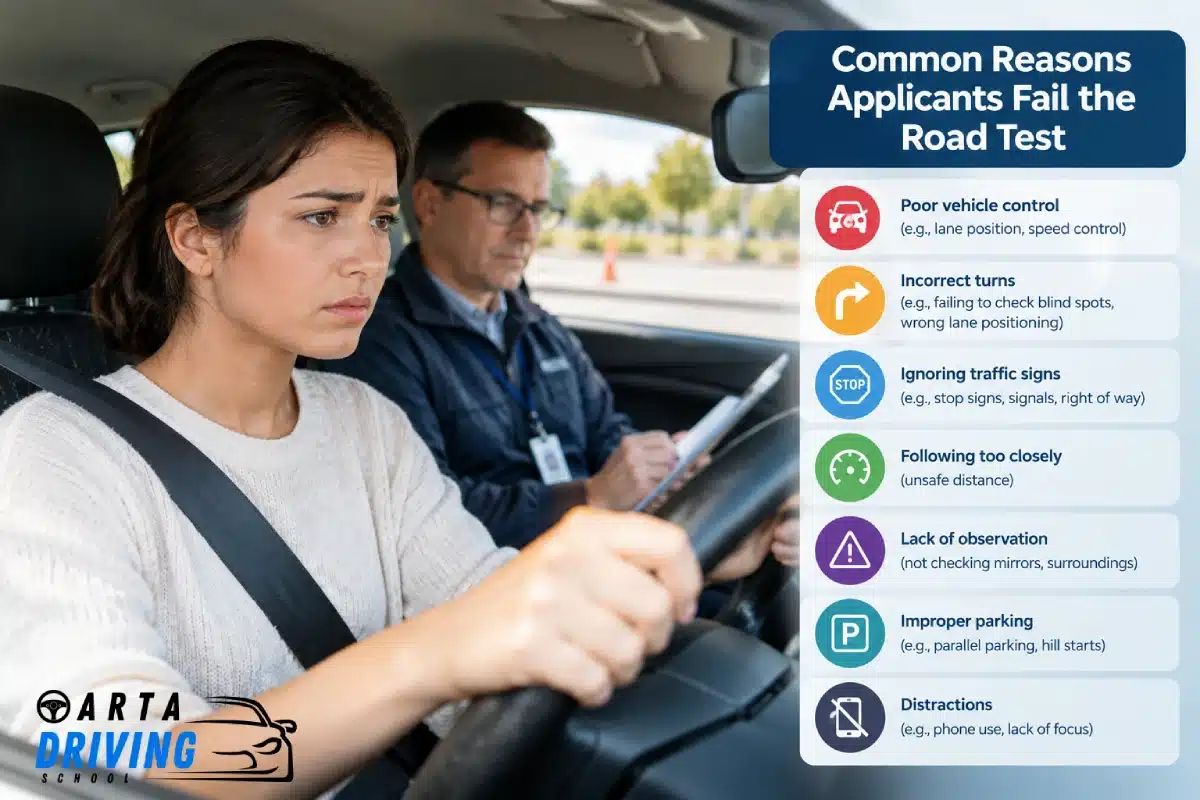
Common Reasons Applicants Fail the Road Test
Based on patterns observed across hundreds of BC road test coaching sessions, these are the most frequent failure points:
- Poor mirror and shoulder-check habits — commercial examiners check this more strictly than on a standard Class 5 test.
- Harsh braking or acceleration — acceptable in a personal car, but marked down heavily in passenger-vehicle testing because it affects passenger comfort and safety.
- Incorrect curb distance when stopping — important for real-world taxi/shuttle pickups and drop-offs.
- Hesitation at intersections or merges, which signals a lack of confidence examiners associate with real-world passenger risk.
- Unfamiliarity with the test vehicle — applicants who rent or borrow a vehicle they’ve never driven often struggle with size and blind spots.
- Not understanding wheelchair/accessibility procedures (where applicable to the vehicle type).
How a Class 4 Driving School Helps You Pass Faster
A dedicated class 4 driving school does more than teach you to drive — it prepares you for the specific evaluation criteria ICBC examiners use for commercial licenses.
What professional Class 4 lessons typically include:
- Practice in a vehicle similar to what you’ll use on test day
- Route familiarization for common ICBC test routes in Burnaby, Vancouver, North Vancouver, and Coquitlam
- Passenger-safety technique coaching (smooth braking, curb awareness, mirror checks)
- Mock road tests with instructor feedback
- Guidance on paperwork, medical report timing, and booking your official test
Why this matters for working professionals: Many Class 4 applicants are career-changers juggling a current job while preparing for a new one as a taxi, rideshare, or shuttle driver. Structured lessons compress the learning curve, reducing the number of road test attempts (and re-booking fees) needed to pass.
Professional Recommendation: Even experienced Class 5 drivers benefit from at least a few hours of Class 4-specific coaching, because the evaluation standard for passenger vehicles is measurably different from a standard driver’s test — not harder in difficulty, but different in focus.
Cost of Getting a Class 4 License
Exact fees for ICBC applications, medical exams, knowledge tests, and road tests change periodically, and vary by medical provider. Rather than publish numbers that may be outdated by the time you read this, confirm current fees directly from:
- ICBC’s official fee schedule: icbc.com
- Your physician/nurse practitioner’s office for medical exam cost
- ARTA Driving School for current Class 4 lesson package pricing
What to budget for:
- Driver’s medical exam fee (paid to your healthcare provider)
- ICBC application/licensing fee
- Knowledge test fee (if applicable)
- Road test fee
- Driving lesson packages (optional but recommended)
- Potential re-test fee if you don’t pass on the first attempt
Timeline: How Long Does the Process Take?
| Stage | Typical Timeframe* |
|---|---|
| Booking a medical exam | 1–2 weeks (depends on doctor availability) |
| ICBC application processing | Same day to a few days |
| Knowledge test (if required) | Can often be done same-day at an ICBC office |
| Driving lessons/practice | 1–4 weeks depending on starting skill level |
| Road test booking wait time | Varies by location and season — can range from days to several weeks |
| Total estimated timeline | 3–8 weeks, depending on test availability in your area |
Timeframes are general estimates based on common applicant experiences and are not official ICBC guarantees. Road test booking availability fluctuates by region and season.
Pros and Cons of Becoming a Commercial Driver
Pros
- Opens job opportunities in taxi, rideshare, limousine, and shuttle industries
- Often flexible working hours (especially rideshare/limo work)
- Transferable credential recognized across multiple commercial driving jobs in BC
- Can lead to higher-class commercial licenses (Class 3, 2, or 1) later
Cons
- Requires ongoing medical re-certification, unlike a standard Class 5 license
- Driving record is held to a stricter standard — violations can jeopardize your commercial license
- Road test failure means added cost and wait time for re-booking
- Insurance and vehicle requirements for for-hire work can be more complex
Checklist: Documents Needed for Your Road Test
- Valid BC Class 5 or Class 7 (full privilege) driver’s license
- Completed Driver’s Medical Examination Report (submitted and approved by ICBC)
- Knowledge test confirmation (if required)
- Booking confirmation for your road test appointment
- A roadworthy, insured vehicle representative of the Class 4 category
- Valid vehicle registration and insurance documents
- Government-issued photo ID
- Payment for road test/application fees
Frequently Asked Questions
What is a Class 4 license in BC?
A Class 4 license is a commercial driving credential required to operate taxis, limousines, ambulances, and small-to-medium buses (up to 20 passengers) in British Columbia. It requires a medical exam and typically a road test beyond standard Class 5 licensing.
What’s the difference between Class 4 Restricted and Class 4 Unrestricted?
Class 4 Restricted allows driving smaller for-hire vehicles (10 passengers or fewer), commonly used by rideshare drivers. Class 4 Unrestricted covers taxis, limousines, ambulances, and larger buses up to 20 passengers.
Do I need a knowledge test to get a Class 4 license?
Most first-time Class 4 applicants are required to complete a knowledge test covering commercial passenger transport rules. Confirm your specific requirement with ICBC, as this can vary by applicant history.
Can I drive for Uber or Lyft with just a Class 5 license in BC?
No. Ride-hailing drivers in BC are generally required to hold a Class 4 license (typically Restricted) in addition to meeting the platform’s own driver requirements.
What vehicle do I need for the Class 4 road test?
You need a roadworthy, insured vehicle that represents the category you’re testing for — a standard car for rideshare/taxi testing, or a van/bus if pursuing the Unrestricted class for bus driving.
How often do I need to renew my medical report for a Class 4 license?
ICBC requires periodic medical re-certification for commercial drivers, with renewal frequency generally increasing as drivers get older. Confirm your exact renewal schedule directly with ICBC, as intervals can be updated.
Can a new driver with a learner’s license (N or L) apply for Class 4?
No. Applicants must hold a full-privilege Class 5 or Class 7 license (not in learner stage) before applying for Class 4.
What happens if I fail the Class 4 road test?
You’ll need to book a re-test, which typically involves an additional fee and wait time. Many applicants use this gap to take targeted driving lessons addressing the specific areas they struggled with.
Is an air brake endorsement required for a Class 4 license?
Air brake endorsement is a separate credential required only if the vehicle you’re driving is equipped with air brakes. Confirm vehicle specifications with your employer or ICBC to determine if this applies to you.
How long does it take to get a Class 4 license in BC?
Most applicants complete the process in roughly 3 to 8 weeks, depending on medical exam scheduling, lesson preparation time, and road test booking availability in their area.
Does ARTA Driving School offer Class 4 lessons?
Yes. ARTA Driving School provides Class 4 driving lessons and road test preparation in Burnaby, Vancouver, North Vancouver, and Coquitlam, including mock tests and route-specific coaching.
Ready to get started? Book your Class 4 driving lesson with ARTA Driving School today and prepare with instructors who know exactly what BC examiners look for in Burnaby, Vancouver, North Vancouver, and Coquitlam.