

Quick Answer
The easiest way to master parallel parking is to use the same repeatable sequence every time: choose a large enough space, signal, position your vehicle correctly beside the car in front, complete your safety checks, reverse slowly, turn toward the curb, straighten the wheels at the right reference point, then counter-steer to bring the front of the vehicle into the space.
The key is not to memorize a single steering trick. Your vehicle’s size, seating position and visibility affect your reference points. Instead, learn a consistent setup and use slow speed, continuous observation and small corrections. For drivers preparing for a B.C. road test, ICBC specifically emphasizes mirror checks, signals, shoulder checks, smooth control and the correct distance from the curb and other vehicles.
What Is the Easiest Way to Parallel Park?
The easiest way to parallel park is to break the maneuver into three simple stages: set up, reverse into the space, and straighten the vehicle.
Start by finding a space that gives you enough room to maneuver safely. Signal your intention to park and pull up beside the vehicle in front of the space. Keep a consistent side gap and position your vehicle roughly parallel to the parked car.
Before reversing, check your mirrors, blind spots and the area around your vehicle. Then reverse very slowly while turning the steering wheel toward the curb. As the vehicle reaches the appropriate angle, straighten the wheels and continue reversing. Once the front of your vehicle has cleared the car ahead, counter-steer to bring the front end into the parking space.
The important part is consistency. Instead of trying to improvise every attempt, use the same sequence and adjust the reference points for the vehicle you are driving.
How Should I Position My Car Before Parallel Parking?
Your starting position has a major effect on the rest of the maneuver.
Pull alongside the vehicle parked directly in front of the space. Your vehicle should be reasonably parallel to it, with enough lateral clearance to allow your front end to swing safely while reversing.
ICBC’s current parallel-parking guidance recommends stopping about one metre away from the vehicle ahead and positioning your vehicle so that its rear is approximately even with the rear of the other vehicle. ICBC also recommends choosing a space with enough room, with at least one-and-a-half car lengths suggested for the maneuver.
Avoid starting too far away. A large gap can change the angle of your turn and make it harder to reach the curb.
Avoid starting too close as well. You need sufficient clearance to maneuver without contacting the vehicle beside you.
Think of the setup as the foundation of the entire maneuver. If the foundation is wrong, the corrections become much harder.
When Should I Turn the Steering Wheel While Parallel Parking?
Timing your steering is one of the most important parallel parking skills.
Once you have completed your safety checks and begun reversing slowly, turn the steering wheel toward the curb to guide the rear of your vehicle into the parking space.
Continue reversing at a controlled speed until your vehicle reaches approximately a 45-degree angle relative to the curb. This is a commonly used reference point in parallel parking instruction, including ICBC’s own guidance.
At this point, straighten the steering wheel and continue reversing.
Once the front of your vehicle has cleared the vehicle in front of the space, turn the steering wheel in the opposite direction. This counter-steering movement brings the front of your vehicle into the parking space.
The sequence is essentially:
Turn toward the curb → straighten → turn away from the curb → straighten and center.
Do not rush the steering transitions. The car should move slowly while your steering inputs remain deliberate.
What Reference Points Should I Use for Parallel Parking?
Reference points can make parallel parking much easier because they give you visual cues for when to change your steering direction.
Common reference points include:
- The rear bumper of the vehicle ahead
- The rear edge of the vehicle’s side window
- The position of the other vehicle in your side mirror
- The angle of your vehicle relative to the curb
- The point at which your front end clears the vehicle ahead
- The curb appearing at a specific position in your mirror
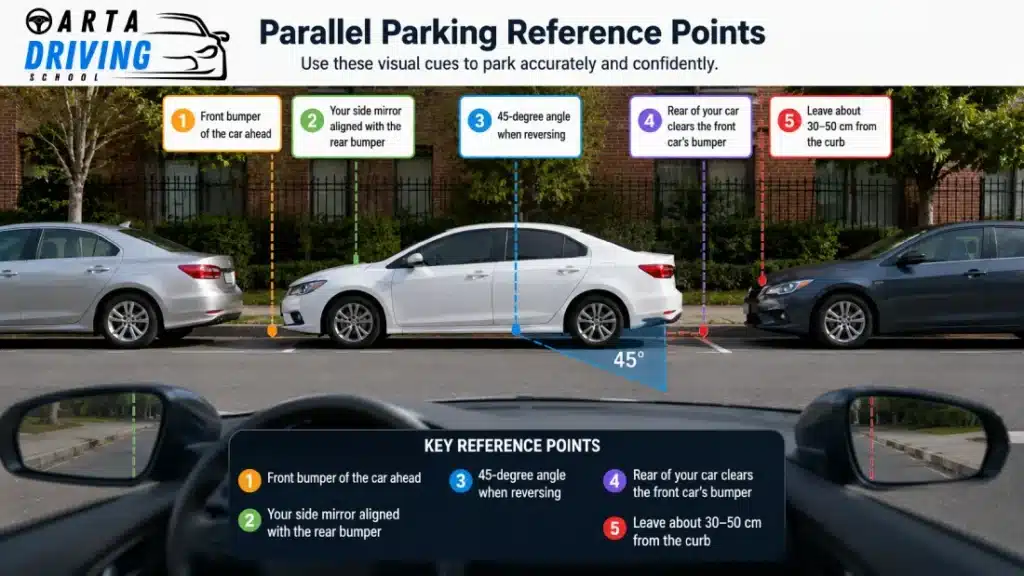 However, there is no universal reference point that works perfectly for every vehicle.
A compact car, SUV and pickup truck have different dimensions and visibility. Even two drivers using the same vehicle can have slightly different visual reference points because their seating positions differ.
That is why the best approach is to establish reference points in the exact vehicle you will normally drive or use for your road test.
Modern driving guides also emphasize that reference points are vehicle-specific and work best when your initial setup remains consistent.
How Can I Avoid Hitting the Curb When Parallel Parking?
The biggest mistake is focusing exclusively on the curb.
You need to monitor the curb, other vehicles, pedestrians and the overall position of your vehicle throughout the maneuver.
Reverse slowly enough that you have time to make a steering correction. Use your mirrors, but do not rely exclusively on one mirror or the backup camera.
If your rear wheel is approaching the curb too quickly, a small steering adjustment can change your trajectory. Avoid making large, sudden corrections because they can create a new problem at the opposite end of the vehicle.
The goal is not to finish as close to the curb as physically possible. The goal is to finish safely, legally and reasonably close to the curb while remaining parallel.
For B.C. drivers preparing for an ICBC road test, the official preparation material specifically evaluates whether the driver stops at the correct distance from the curb and from other vehicles.
How Important Are Mirrors and Blind-Spot Checks When Parallel Parking?
They are essential.
Parallel parking is not simply a steering exercise. You are reversing a vehicle into an area where pedestrians, cyclists and other vehicles may be present.
Before beginning the maneuver, check your surroundings carefully. Continue observing while reversing and use the appropriate mirror and shoulder checks as the vehicle moves.
ICBC specifically recommends a 360-degree check before beginning parallel parking and identifies observation as an important part of successful road-test performance.
Do not let a backup camera replace your observations. A camera can provide useful information, but it does not eliminate blind spots or replace direct visual checks.
A good habit is to think:
Observe → move slowly → observe again → adjust.
That rhythm is much safer than staring at a single reference point until the car is parked.
What Are the Most Common Parallel Parking Mistakes?
Most parallel parking mistakes come from poor positioning, excessive speed or incorrect steering timing.
Starting too far from the parked car
A large initial gap can make the maneuver awkward and change the angle of entry.
Starting too close
This reduces your maneuvering room and increases the risk of contacting the other vehicle.
Turning too early
An early turn can send the rear of the vehicle too deeply toward the curb.
Turning too late
A late turn can leave the vehicle too far away from the curb or make it difficult to fit into the space.
Reversing too quickly
Speed reduces your reaction time and makes corrections harder.
Forgetting shoulder checks
Looking only in the mirrors is not enough. Blind spots can contain pedestrians, cyclists or vehicles.
Focusing on one reference point
Reference points are useful, but they should never replace continuous observation.
Refusing to correct the vehicle
A small correction is often better than trying to force the car into position with one continuous movement.
ICBC’s road-test guidance emphasizes smoothness, control, observation and appropriate space margins rather than treating parallel parking as a simple steering-wheel trick.
Can I Correct My Position If I Make a Mistake While Parallel Parking?
Yes. A correction is often the safest option when your vehicle is not positioned correctly.
If you realize that you are too far from the curb, too close to another vehicle or not properly centered, slow down and make a controlled adjustment rather than continuing with a poor trajectory.
For example, you may need to move slightly forward and then reverse again to improve your final position.
The important distinction is between a controlled correction and a rushed reaction.
Do not panic if the vehicle does not look perfect after the first steering movement. Parallel parking involves judging several distances simultaneously, and learning to make small corrections is part of becoming a competent driver.
For road-test preparation, remember that the examiner is evaluating your overall driving skills, including observation, control and safe positioning. ICBC states that examiners are not looking for perfection, but they do expect drivers to demonstrate safe, smooth and controlled driving.
What Should I Know About Parallel Parking on a Driving Test?
If you are preparing for a driving test, do not practice parallel parking as an isolated steering exercise.
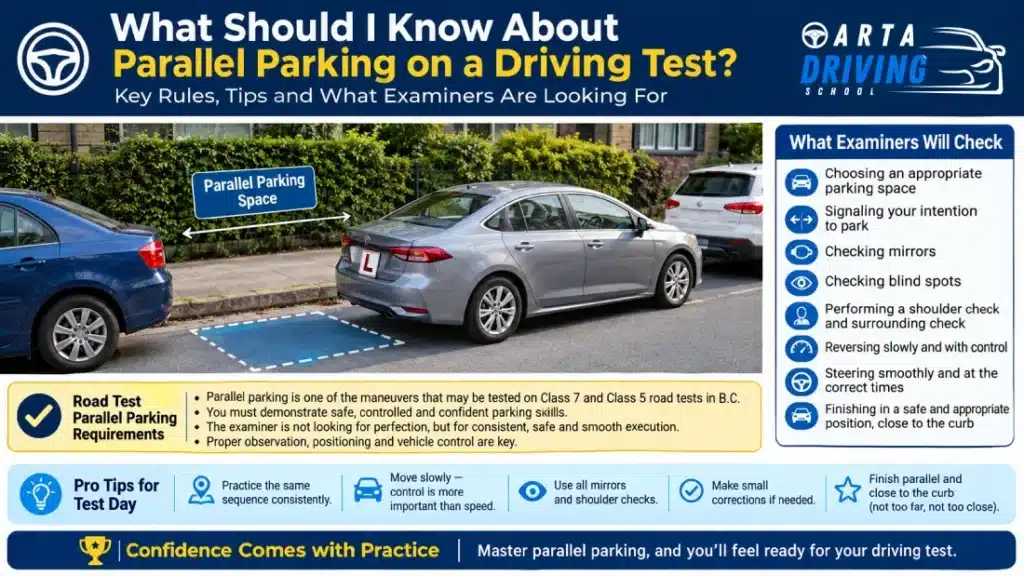
Examiners are looking at the complete maneuver.
That includes:
- Choosing an appropriate parking space
- Signaling your intention
- Checking mirrors
- Checking blind spots
- Performing the appropriate shoulder and surrounding checks
- Controlling your speed
- Maintaining safe space from other vehicles
- Steering smoothly
- Avoiding contact with the curb or other vehicles
- Finishing in a safe and appropriate position
For B.C. drivers, ICBC lists parallel parking among the maneuvers that may be tested on Class 7 and Class 5 road tests. Its preparation material specifically highlights mirror checks, signals, shoulder checks, smooth execution and correct positioning.
ICBC also reports that parallel parking remains one of the maneuvers B.C. drivers find most challenging, with 59% of surveyed drivers identifying it as the most difficult maneuver to learn.
So if parallel parking makes you nervous, you are certainly not the only learner struggling with it.
How Can I Practice Parallel Parking and Become Confident?
The fastest way to improve is to practice the same sequence repeatedly, rather than performing random attempts.
Start somewhere quiet and use cones or other appropriate markers to simulate parked vehicles. Begin with a large space and concentrate on your starting position, speed, steering sequence and observation.
Once you can complete the maneuver consistently, gradually reduce the available space.
A useful practice routine is:
Practice 1: Focus only on the starting position.
Practice 2: Focus on reversing slowly and controlling the steering.
Practice 3: Add your mirror, shoulder and 360-degree checks.
Practice 4: Practice correcting your position when necessary.
Practice 5: Practice in realistic street conditions.
Practice 6: Perform several attempts without instructor assistance.
ICBC recommends practicing challenging maneuvers such as parallel parking until they feel smooth and using the same vehicle you practiced with when possible.
Do not measure improvement by whether you can park perfectly once.
Measure it by whether you can repeat the maneuver safely several times in a row.
Final Parallel Parking Checklist
Before you reverse into a parallel parking space, remember:
- Choose a space large enough for your vehicle.
- Signal your intention to park.
- Position your vehicle correctly beside the vehicle ahead.
- Maintain a safe side distance.
- Check your mirrors.
- Check your blind spots.
- Complete your surrounding safety check.
- Reverse slowly.
- Turn toward the curb at your reference point.
- Straighten the wheels.
- Continue reversing until the front clears the vehicle ahead.
- Counter-steer to bring the front into the space.
- Straighten the wheels.
- Make a controlled correction if necessary.
- Finish safely and reasonably close to the curb.
The Most Important Parallel Parking Tip
Don’t try to memorize a complicated steering trick.
Master your starting position, move slowly, use reliable reference points, keep checking your surroundings and make controlled corrections when necessary.
Once those five habits become automatic, parallel parking stops feeling like a high-pressure geometry exam and starts becoming a predictable driving maneuver.
Ready to Become More Confident Behind the Wheel?
Parallel parking is much easier when an experienced instructor can identify exactly when you are turning too early, positioning too far away, missing a shoulder check or using the wrong reference point for your vehicle.
If you’re preparing for your road test or simply want to become more confident with parking, professional one-on-one driving instruction can help you turn repeated mistakes into consistent driving habits.
Want to master parallel parking before your road test? Book a professional driving lesson and practice the maneuver with an experienced instructor. Build your confidence, improve your parking technique and arrive at your road test feeling prepared.Book Your Driving Lesson Today →